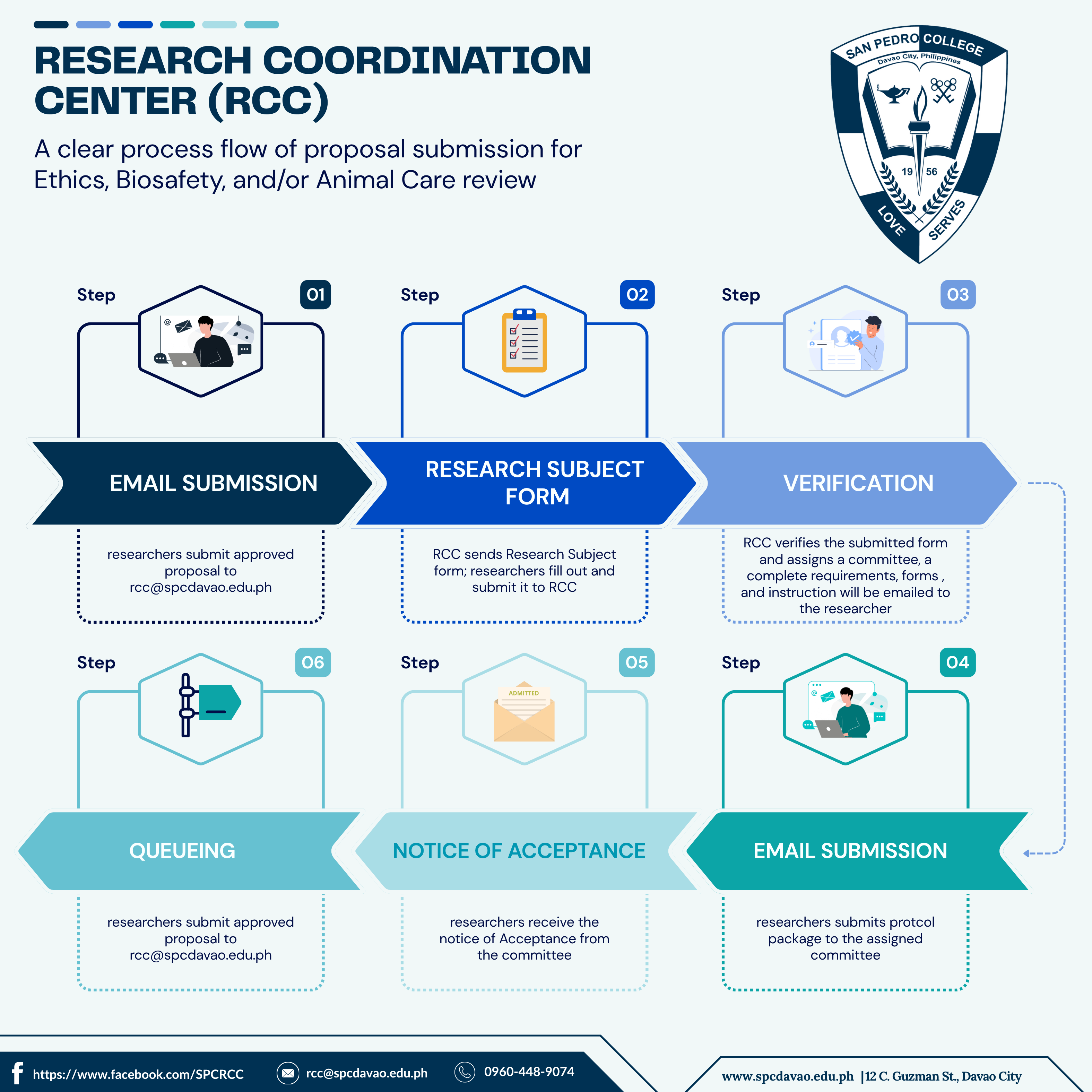
GUIDELINES: SPC-IBC REVIEW GUIDELINES
CHECKLIST: SPC IBC Checklist
GUIDELINES: SPC-IACUC REVIEW GUIDELINES
FORMS: SPC-IACUC FORM
The Research Coordination Center is an office under the Research, Publication, and Innovation Center of San Pedro College. Its primary purpose is to support and streamline the activities of the organization, ensuring that research projects are conducted efficiently, ethically, and in accordance with relevant regulations and guidelines. It is dedicated to warrant effective coordination of research efforts and provide researchers with the necessary support to carry out their work successfully. The institution created the Research Coordination Center with the following oversight committees: Research Ethics Committee (REC), Institutional BioRisk Committee (IBC), and Institutional Animal Care and Use Committee (IACUC).

GUIDELINES: SPC-IBC REVIEW GUIDELINES
CHECKLIST: SPC IBC Checklist
GUIDELINES: SPC-IACUC REVIEW GUIDELINES
FORMS: SPC-IACUC FORM
GET LATEST UPDATES



1.1 issuance of certificate of approval
1.2 issuance of certificate of completion
1.3 issuance of certificate of exemption
1.4 post-study monitoring
2.1 issuance of certificate of approval
2.2 issuance of certificate of completion
3.1 issuance of certificate of approval
3.2 issuance of certificate of completion


All submissions are processed online through the Research Coordination Center (RCC). Once your research proposal has been approved by your adviser, panel, or department, send the complete and final version to:
Make sure your submission includes all required attachments (e.g., informed consent forms, research instruments, endorsement letters), as incomplete submissions may delay the review process. It is advisable to save all submission confirmations for your records.
The Research Coordination Center (RCC) oversees three main committees, each responsible for a specific area of ethical and safety review:
Depending on the nature of your research, your proposal may be reviewed by one or more of these committees. For example, a study involving both human blood samples and laboratory animals may require clearance from more than one committee.
The turnaround time depends on the type of review your proposal undergoes:
Timelines may be affected by the completeness of your submission and the volume of proposals being reviewed at the time. Researchers are encouraged to submit early to allow time for possible revisions.
You are required to first secure a Certification Precondition (CP) or clearance from the National Commission on Indigenous Peoples (NCIP) before your proposal can proceed to ethics review. This is a legal requirement under Philippine law (Republic Act No. 8371, or the Indigenous Peoples’ Rights Act) to ensure that research involving Indigenous communities respects their rights, culture, and Free and Prior Informed Consent (FPIC). Without this certification, the REC will not be able to process your application.
The REC is responsible for reviewing research proposals that involve human participants. Its main functions include:
The IBC evaluates research involving biological materials, such as microorganisms, recombinant DNA, biohazardous substances, or infectious agents. Its responsibilities include:
The IACUC reviews and monitors research protocols involving animal subjects. Its key responsibilities include:


Copyright © 2025 San Pedro College, All Rights Reserved. SPC Official Website.
| Terms and Conditions | Data Privacy Statement | Privacy Notice |
| Cookie | Duration | Description |
|---|---|---|
| cookielawinfo-checbox-analytics | 11 months | This cookie is set by GDPR Cookie Consent plugin. The cookie is used to store the user consent for the cookies in the category "Analytics". |
| cookielawinfo-checbox-functional | 11 months | The cookie is set by GDPR cookie consent to record the user consent for the cookies in the category "Functional". |
| cookielawinfo-checbox-others | 11 months | This cookie is set by GDPR Cookie Consent plugin. The cookie is used to store the user consent for the cookies in the category "Other. |
| cookielawinfo-checkbox-necessary | 11 months | This cookie is set by GDPR Cookie Consent plugin. The cookies is used to store the user consent for the cookies in the category "Necessary". |
| cookielawinfo-checkbox-performance | 11 months | This cookie is set by GDPR Cookie Consent plugin. The cookie is used to store the user consent for the cookies in the category "Performance". |
| viewed_cookie_policy | 11 months | The cookie is set by the GDPR Cookie Consent plugin and is used to store whether or not user has consented to the use of cookies. It does not store any personal data. |