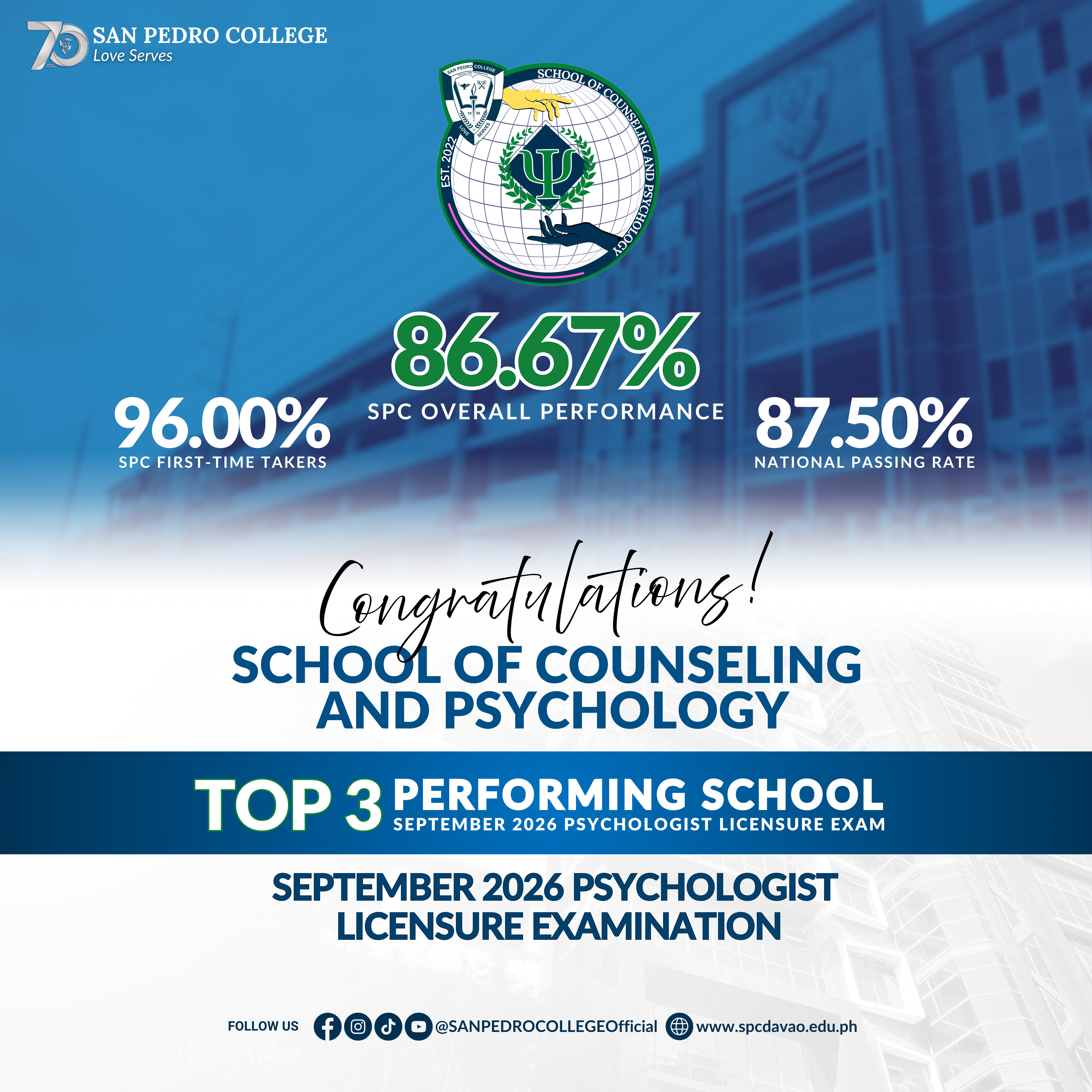
SCHOOL OF COUNSELING AND PSYCHOLOGY

GRADUATE SCHOOL PROGRAM OFFERED

Doctor of Philosophy (Ph.D.) in Guidance and Counseling

This program is designed to train postgraduate students to become adept not only on the rudiments of counseling practice but also on the development of skills and techniques that may be used in making diagnosis and in effecting interventions to various cases in the helping profession. The program uses the experiential and instructional approaches in dealing with issues and concerns in school counseling, industrial counseling, and community counseling – the three major areas of the program.

  1. Be recognized as a multiculturally competent scientist-practitioner.
  2. Gain recognition or awards in the practice of the profession.
  3. Pursue professional development programs through trainings, certifications or post-doctoral degree.
  1. Demonstration of highly advanced systematic knowledge and skills in highly specialized and/or complex interdisciplinary or multidisciplinary field of learning.
  2. Utilization of complex research / creative work and/or professional practice and or the advancement of learning with full independence individual work and or in terms of interdisciplinary or multidisciplinary setting.
  3. Application of more complex setting that demands leadership in research and creative work with strategic value added.
  4. Application of significant of expertise – based autonomy and accountability to professional leadership for innovation, research, and or development management and highly specialized interdisciplinary or multidisciplinary field.

MA in Guidance & Counseling

These programs are designed to train graduate students to become better persons, more effective professional guidance counselors. The courses are organized in a way that students are equipped with strong foundation in the theories and fundamental principles of psychology, philosophy, social research, and guidance counseling. To achieve these ends, the programs are focused on the integration of theory and practice.

  1. Achieve a high level of technical expertise as manifested by the passing of the licensure examination.
  2. Occupy key positions in Guidance and Counseling and allied professions.
  3. Exhibit proficiency in applying knowledge and skills in meeting the psychological needs of multiculturally diverse groups in school and community settings.
  1. Advanced knowledge and skills in a specialized interdisciplinary or multidisciplinary field of study / or professional practice.
  2. Evaluate and integrate relevant research findings and professional output to make evidence-based decision or resolutions related to guidance and counseling practice.
  3. Use information technology and knowledge-based resources to manage and transform data that inform counseling practice.
  4. Lifelong learning with a highly substantial degree of independence that involves individual work or teams of interdisciplinary or multidisciplinary experts.
  5. Application of the acquired skills in research, professional, or creative work.
  6. Publish or present research papers in peer-reviewed journals and conferences respectively.

MA in Industrial Counseling

These programs are designed to train graduate students in counseling; become attuned in applying the theories, principles, methods, and techniques of guidance and counseling in the various activities in business and industry. Graduate students are envisioned to be equipped with the knowledge on how counseling theories and practices can be of help in making the workplace become more inter-active and fulfilling. The programs make use of experiential approach in instruction.

  1. Occupy related key positions in the industrial and other related setting.
  2. Contribute to enhancing worker satisfaction and productivity through evidence–based strategies and programs.
  3. Be recognized as a competent practitioner in the area of industrial counseling and other allied professions.
  4. Exhibit proficiency in applying knowledge and skills in meeting the needs of multicultural groups.
  1. Advanced knowledge and skills in a specialized interdisciplinary or multidisciplinary field of study / or professional practice.
  2. Evaluate and integrate relevant research findings and professional output to make evidence-based decision or resolutions related to guidance and counseling practice.
  3. Lifelong learning with a highly substantial degree of independence that involves individual work or teams of interdisciplinary or multidisciplinary experts.
  4. Application of the acquired skills in research, professional, or creative work.
  5. Publish or present research papers in peer-reviewed journals and conferences respectively.

MS in Psychology

These programs envision to train and provide schools, rehabilitation facilities, industries, and the community at large with highly proficient, competent and passionate professionals in the field of psychology. It further aims to produce graduates who adhere strongly to the moral and ethical standard in the practice of profession, humane in attributes, and compassionate in the performance and delivery of their professional services.

  1. Occupy key positions in psychology-related professional organizations
  2. Gain recognition or awards in the practice of the profession or research
  3. Pursue professional development programs through trainings, certifications or post graduate degree
  1. Advanced knowledge and skills in a specialized interdisciplinary or multidisciplinary field of study / or professional practice.
  2. Evaluate and integrate relevant research findings and professional output to make evidence-based decision or resolutions related to I/O psychology.
  3. Lifelong learning with a highly substantial degree of independence that involves individual work or teams of interdisciplinary or multidisciplinary experts.
  4. Application of the acquired skills in research, professional, or creative work.
  5. Publish or present research papers in peer-reviewed journals and conferences respectively.

Master in Guidance & Counseling | Non-thesis tracks

These programs are designed to train graduate students to become better persons, more effective professional guidance counselors. The courses are organized in a way that students are equipped with strong foundation in the theories and fundamental principles of psychology, philosophy, social research, and guidance counseling. To achieve these ends, the programs are focused on the integration of theory and practice.

  1. Achieve a high level of technical expertise as manifested by the passing of the licensure examination.
  2. Occupy key positions in Guidance and Counseling and allied professions.
  3. Exhibit proficiency in applying knowledge and skills in meeting the psychological needs of multiculturally diverse groups in school and community settings.
  1. Advanced knowledge and skills in a specialized interdisciplinary or multidisciplinary field of study / or professional practice.
  2. Evaluate and integrate relevant research findings and professional output to make evidence-based decision or resolutions related to guidance and counseling practice.
  3. Use information technology and knowledge-based resources to manage and transform data that inform counseling practice.
  4. Lifelong learning with a highly substantial degree of independence that involves individual work or teams of interdisciplinary or multidisciplinary experts.
  5. Application of the acquired skills in research, professional, or creative work.
  6. Publish or present research papers in peer-reviewed journals and conferences respectively.

Master in Industrial Counseling | Non-thesis tracks

These programs are designed to train graduate students in counseling; become attuned in applying the theories, principles, methods, and techniques of guidance and counseling in the various activities in business and industry. Graduate students are envisioned to be equipped with the knowledge on how counseling theories and practices can be of help in making the workplace become more inter-active and fulfilling. The programs make use of experiential approach in instruction.

  1. Occupy related key positions in the industrial and other related setting.
  2. Contribute to enhancing worker satisfaction and productivity through evidence – based strategies and programs.
  3. Be recognized as a competent practitioner in the area of industrial counseling and other allied professions.
  4. Exhibit proficiency in applying knowledge and skills in meeting the needs of multicultural groups.
  1. Advanced knowledge and skills in a specialized interdisciplinary or multidisciplinary field of study / or professional practice.
  2. Evaluate and integrate relevant research findings and professional output to make evidence-based decision or resolutions related to guidance and counseling practice.
  3. Lifelong learning with a highly substantial degree of independence that involves individual work or teams of interdisciplinary or multidisciplinary experts.
  4. Application of the acquired skills in research, professional, or creative work.
  5. Publish or present research papers in peer-reviewed journals and conferences respectively.

Master in Psychology | Non-thesis tracks

These programs envision to train and provide schools, rehabilitation facilities, industries, and the community at large with highly proficient, competent and passionate professionals in the field of psychology. It further aims to produce graduates who adhere strongly to the moral and ethical standard in the practice of profession, humane in attributes, and compassionate in the performance and delivery of their professional services.

  1. Occupy key positions in psychology-related professional organizations
  2. Gain recognition or awards in the practice of the profession or research
  3. Pursue professional development programs through trainings, certifications or post graduate degree
  1. Advanced knowledge and skills in a specialized interdisciplinary or multidisciplinary field of study / or professional practice.
  2. Evaluate and integrate relevant research findings and professional output to make evidence-based decision or resolutions related to I/O psychology.
  3. Lifelong learning with a highly substantial degree of independence that involves individual work or teams of interdisciplinary or multidisciplinary experts.
  4. Application of the acquired skills in research, professional, or creative work.
  5. Publish or present research papers in peer-reviewed journals and conferences respectively.

ADMINISTRATORS

Dean & Program Coordinators

Henry M. Yap

Dean, School of Counseling and Psychology (SCP) Program Coordinator, Graduate School (MAGC)

Henry M. Yap, RGC, Ph.D.

Specializations / Subjects Taught

  • Strategic HRM
  • Research in Psychology
  • Career Counseling and Development
  • Foundations of Guidance and Counseling
  • Psychology Testing

View Profile

Ruth Marie D. Zosa

Associate Dean, School of Counseling and Psychology (SCP)

Ruth Marie D. Zosa, RPm, RPsy

Specializations / Subjects Taught

  • Strategic HRM
  • Practicum in Psychology

View Profile

Maria Fe R. Solera

MSP & MP Program Coordinator, Graduate School / Internship Coordinator (SCP)

Maria Fe R. Solera, RGC, Ph.D.

Specializations / Subjects Taught

  • Field Methods of Psychology
  • Cognitive Psychology
  • Family Systems Psychotherapy
  • Disaster Readiness and Risk Reduction Management
  • Practicum in Masters degree in Guidance and Counseling

View Profile

FACULTY MEMBERS

Teaching Faculty

Lea F. Elivera

Faculty, School of Counseling and Psychology (SCP)

Gecelle Grace G. Diez

Faculty, School of Counseling and Psychology (SCP)

Leanza Marzi E. Melendres

Faculty, School of Counseling and Psychology (SCP)

Hazel T. Victoriano

Faculty, School of Counseling and Psychology (SCP)

Teaching Faculty Part-Time

Demie Laine S. Baluis, LPT, MAGC, RGC

Guidance Facilitator, Guidance, Counseling & Testing Center

Neian M. Brillo, RPm, CHRA, RPsy

Psychometrician, Guidance, Counseling & Testing Center

Miguel J. Dumadag, MPsy, RPsy

Assistant Head, Guidance, Counseling & Testing Center

Vanessa D. Serdan, RPm

Psychometrician, Guidance, Counseling & Testing Center

Tuesday Ann R. Tom, RPm, MPsy, RPsy

Head, Guidance, Counseling & Testing Center

Candice Laine Martin-Urbano, RPm

Head, Alumni Affairs Office

Dr. Orencita V. Lozada, RGC, RPsy, CSCLP

Clinical Supervisor, Family Welfare and Wellness Center

Nexan T. Umbod, RPm, CHRA, Rpsy

Guidance Facilitator, Guidance, Counseling & Testing Center

Geraldine B. Vicente, MPsy, RPm, CHRA

Secretary, President Office

Sashi Faye L. Cagampang, MGC

Part-Time Faculty, School of Counseling and Psychology (SCP)

Eman Claudette J. Eng, RPm, RGC, RPsy

Part-Time Faculty, School of Counseling and Psychology (SCP)

Charls A. Gevera, RPm

Part-Time Faculty, School of Counseling and Psychology (SCP)

Katreen Floravel S. Mandin, RPm, MPsy

Part-Time Faculty, School of Counseling and Psychology (SCP)

Gabriellie Marie C. Felio, RPm, CHRA, CMHFR

Part-Time Faculty, School of Counseling and Psychology (SCP)

Kharis Anne P. Taghoy, MSPsy, RPsy, RPm

Part-Time Faculty, School of Counseling and Psychology (SCP)

Cristal Jacinta V. Pimentel, RPm

Part-Time Faculty, School of Counseling and Psychology (SCP)

Non Teaching Personnel

Maha T. Macagba

Academic Secretary, School of Counseling and Psychology (SCP)

Lovelyn F. Salas

Academic Secretary, School of Counseling and Psychology (SCP)

Frequently Asked Questions

School Term and Examinations (As stipulated in the College Handbook)

·       Conflicts in examination schedule must be brought to the attention of the subject teachers prior to the examination schedule. In the event that schedules will not be arranged, the department dean will deal on the matter.

·       Special examinations in a grading period may be given to students when the reason of absence is considered excused.

·       Special examinations will be scheduled by the teacher upon approval of the Dean within ten (10) days after the periodical examination. A student will only have 80% of the raw score. Failure to take the special examination in any grading period will mean a raw score of zero or its grade equivalent for the said examination. The special examination fee is payable at the Cashier’s Office, of which, a special examination permit is issued.

·       Any student who misses a quiz due to excused absence shall be given a special quiz upon presentation of an absence slip from the department concern.

·       No student is allowed to take the periodical examination if he/she arrives after fifteen (15) minutes of the schedules examination. He/she must secure special examination permit before taking the test.

Absence is considered excuse based on the following reasons:

·       Illness with medical certificate issued or validated by the school physician;

·       Death of the immediate member of the family (parents and siblings, spouse and children) with valid death certificate;

·       Attendance or participation in school related activities, provided, there is a validation from the respective authority or written communication to such effect;

·       Calamities in any form upon presentation of proof or evidence; and

·       General transport strike.

Office of Student Affairs – St. Therese Building, 2nd Floor

St. Dominic Building  – Room 207 (SD 207)

Upcoming Events

Official SPC Calendar for AY 2026-2027

UPDATES & ANNOUNCEMENTS

School of Counselling and Psychology Graduate School

Contact Information

St. Dominic Building

Location

Email Us

Contact Us

Connect with Us

Connect with Us | Graduate School

Copyright © 2025 San Pedro College, All Rights Reserved. SPC Official Website.

| Terms and Conditions | Data Privacy Statement | Privacy Notice |

TOP
error: Content is protected !!